
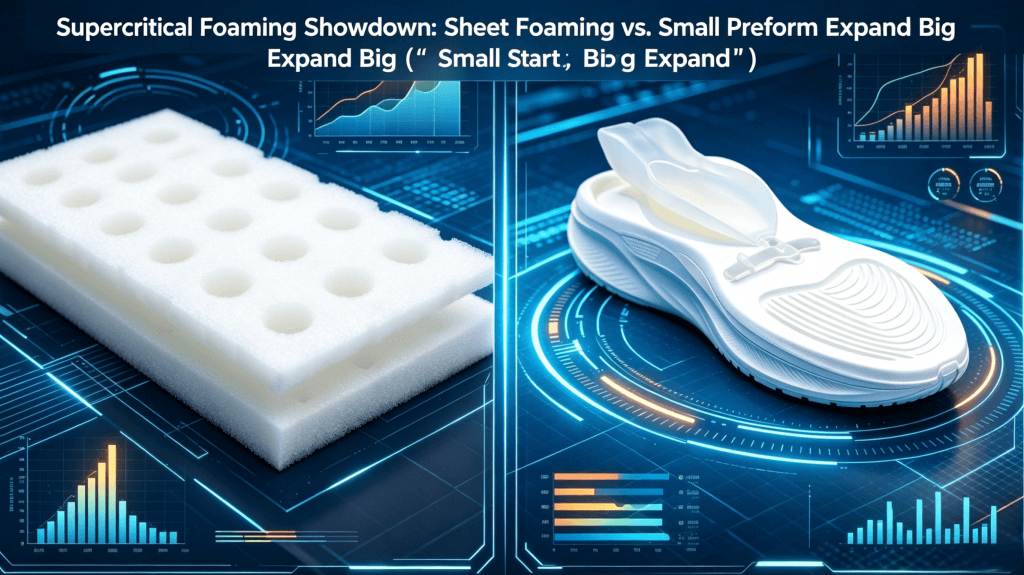
Supercritical physical foaming has become the core manufacturing technology for high-performance athletic footwear midsoles.
Initially, bead popcorn foaming dominated the market. Today, two advanced supercritical routes — sheet foaming and small preform expand big — have taken over mainstream midsole production. Though both rely on supercritical CO₂/N₂ physical foaming, their core process logic, performance output and production positioning are entirely different. Let’s break down their pros, cons and ideal application scenarios.
1. Core Process Route Difference
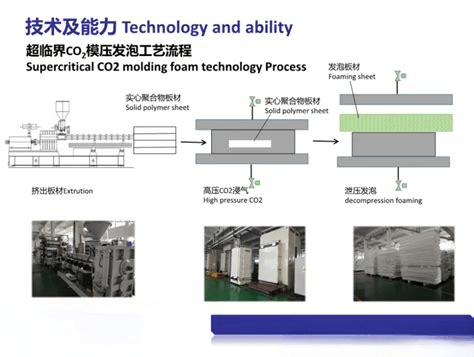
Supercritical Sheet Foaming: Foam First, Shape Later
Polymer raw sheets are loaded into high-pressure autoclaves, fully impregnated with supercritical fluid under high temperature & pressure for gas diffusion. Rapid pressure release creates large uniform foamed slabs. Finished midsoles are then processed via cutting, carving and grinding.
Small Preform Expand Big: Shape First, Foam Later
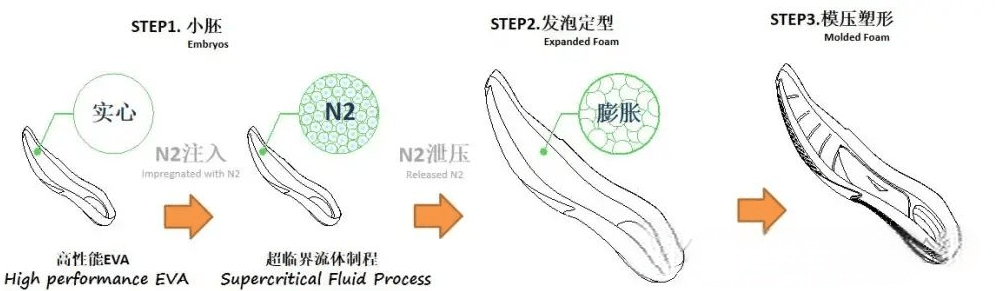
Small-size midsole blanks are injection-molded in advance. Compact preforms go through supercritical fluid saturation, then fully expand inside molds to form complete midsole profiles. A final grinding & secondary compression molding step delivers finished parts.
2. Performance Characteristics Comparison
Sheet Foaming Strengths: Ultra-Light Weight & Top Resilience
Without mold confinement during expansion, materials expand freely to hit ultra-low density ranging from 0.06–0.09 g/cm³, with rebound rate over 80%.
Yield rate reaches above 90% for premium grades like TPEE foam, delivering industry-leading lightweight cushion performance.
Small Preform Expand Big Strengths: Stable Integrated Physical Properties
Secondary compression molding locks foam structure into dense, consistent architecture. It delivers steady rebound uniformity and superior tear resistance for long-term wear durability.
The tradeoff is lower yield rate, averaging around 80%.
3. Forming Capacity, Cycle Time & Mass Production Efficiency
Supercritical Sheet Foaming
- Batch cycle: 3–4.5 hours per autoclave run; manufacturers extend impregnation to 4.5–8 hours for enhanced physical properties. Single autoclave holds large slab capacity.
- Major limitations: Multi-step post-processing (cutting, carving, polishing) restricts complex geometric shaping such as tall side wall details. Material waste hits 40%–50% from trimmings, dragging down mass production throughput.
- Market positioning: Insoles, limited-edition footwear, brand sample development — simple shapes with low mass output demand.
Small Preform Expand Big
- Integrated one-mold forming directly outputs complete midsole outlines, drastically cutting intermediate procedures. Near-net shaping minimizes trimming waste and lifts overall production efficiency.
- Continuous technical iteration drives steady cost reduction, making it the dominant mass-production process for large-volume athletic midsole orders.
Closing Industry Insight
The two supercritical foaming technologies are complementary rather than competitive. Brands and manufacturers can select matching solutions based on product positioning, order volume and design complexity.
At YATE NEW MATERIALS, we supply customized EVA / TPU / TPEE supercritical foam raw materials compatible with both sheet foaming and small preform expand big production lines. Reach out to our technical team for foam formulation matching, performance test reports and mass supply support.
What supercritical foaming challenges is your footwear factory facing right now? Share your thoughts in the comment section.
#YATENewMaterials #SupercriticalFoaming #FootwearMidsole #EVAFOAM #TPUFoam #AthleticFootwear #ShoeMaterial #PhysicalFoaming #SportsFootwearManufacturing #FoamTechnology #SneakerMaterials #FootwearRawMaterial