
Supercritical Foam Insole Molding Technology: Cold Press VS Hot Press
Supercritical foamed sheet stands out among footwear raw materials for ultra-light weight, high rebound rate and stable yield rate, widely used for shoe midsoles and insoles. However, the sheet processing route has obvious bottlenecks:
- Post-cutting & polishing procedures are complicated, hard to form complex 3D sole structures with limited sheet thickness;
- Mechanical cutting causes severe raw material waste, with offcut loss rate up to 40%-50%, restricting mass production capacity.
In general, supercritical foam sheets are more suitable for insoles, simple-shaped soles or small-batch footwear styles. Currently, market penetration is still limited, mainly due to high material & molding costs. Flat-cut insoles lack 3D texture, while traditional hot mold pressing costs too much.
To create arch support & ergonomic curve for flat-cut supercritical foam sheets, manufacturers adopt two core shaping technologies: cold press molding and hot press molding. YATE New Materials sorts out a full comparison for footwear brand factories & foam processors.
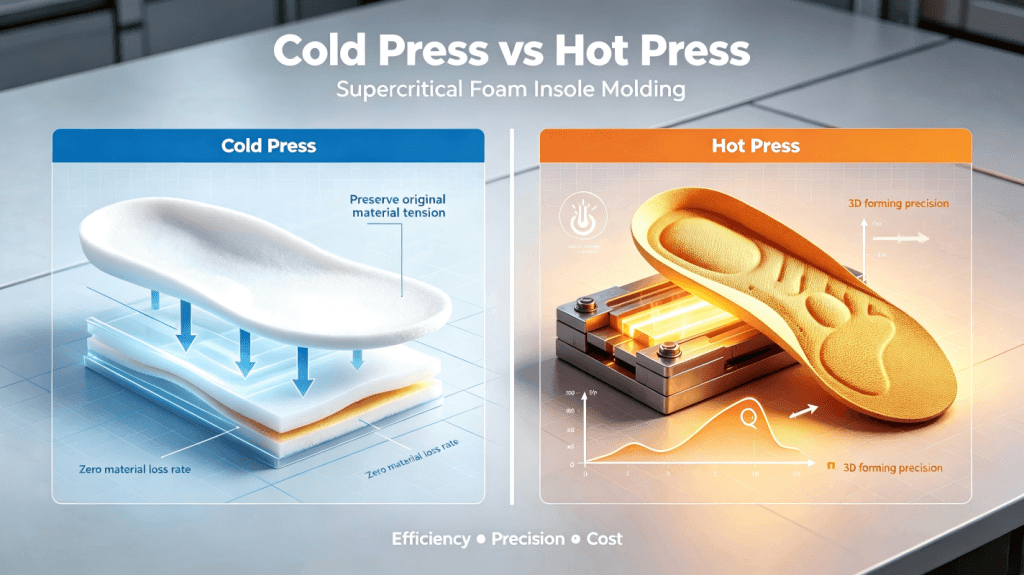
Hot Press Molding: High Precision & Multi-functional Integration
The process puts pre-cut foam sheets into 150-160℃ heated molds, then cool down under pressure to finish shaping.
Advantages
- Ultra-high molding precision, supports complex 3D contours, delicate surface texture & embossed logo;
- Realize one-step lamination of foam, mesh fabric & support sheets under high temperature, highly integrated functional insoles.
Drawbacks
- Continuous mold heating leads to huge energy consumption;
- Long full production cycle (heating + cooling), low output capacity and higher overall manufacturing cost.
Cold Press Molding: Low Cost & High Mass Production Efficiency
Cold press follows a “pre-bake first, room-temperature mold pressing” workflow: soften foam sheets in oven, then transfer instantly to normal-temperature molds and shape under high pressure.
Advantages
- Low operation cost: no continuous mold heating, greatly cuts equipment investment & power consumption;
- Short molding cycle, ideal for large-volume fast mass production;
- Better retention of internal material tension, arch support structure hardly collapses during long-term wear;
- Avoid deformation & rebound defects of traditional chemical foam insoles, finished product performance equals hot-press items.
Industry Outlook
With the gradual cost reduction of supercritical foaming raw materials, cold press technology will unlock large-scale mass production of supercritical foam insoles, becoming the most promising application track for foam sheet manufacturers.
YATE New Materials supplies customized supercritical EVA/PE foam sheets, supporting both cold press & hot press molding solutions for footwear manufacturers worldwide. Contact us for free material samples & customized foam formula consultation.
#SupercriticalFoam #ShoeMaterial #EVAFOAM #FoamInsole #FootwearManufacturing #ColdPressMolding #HotPressMolding #AthleticShoes #ShoeMidsole #FoamTechnology #YATEMaterials #LightweightFootwear