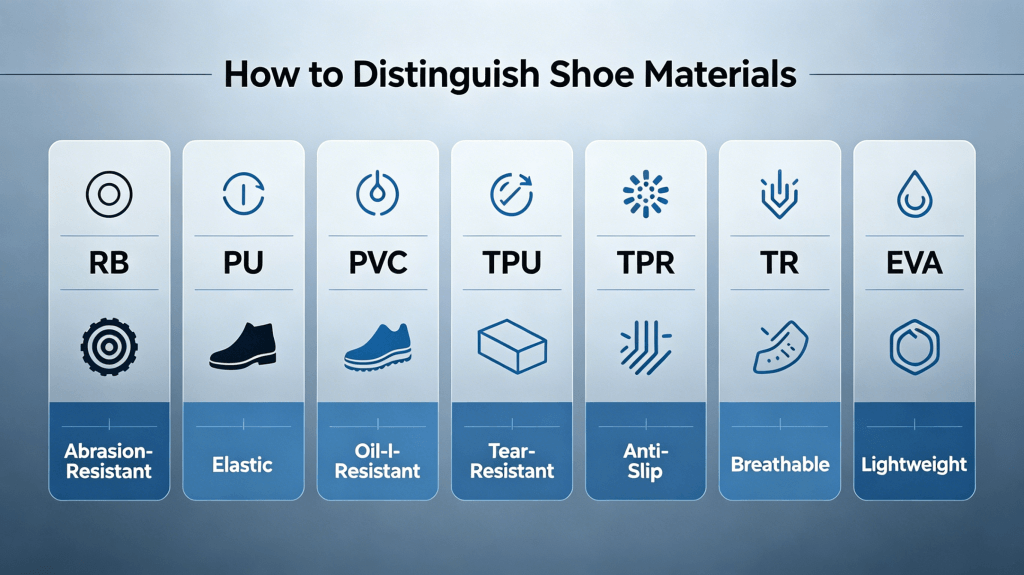
For footwear brands, manufacturers, and procurement teams, choosing the right shoe materials is the foundation of product quality, comfort, and cost control. However, with so many common shoe materials—RB, PU, PVC, TPU, TPR, TR, and EVA—it’s easy to confuse their properties and applications.
As a professional shoe material supplier with rich industry experience, YATE New Materials is here to clarify the key differences, characteristics, and application scenarios of these 7 core shoe materials. This guide will help you make informed decisions, optimize product design, and reduce procurement risks.
1. EVA & MD (PHYLON): Lightweight & Elastic Core Materials
EVA (Ethylene Vinyl Acetate): A lightweight, elastic chemical synthetic material, widely used as an outsole or midsole material. It is often combined with RB (Rubber) for better performance. EVA is cost-effective, and its hardness is controlled by foaming temperature. It is also used in composite materials as foam, which is lightweight and shock-absorbent.
MD (Model/PHYLON): A general term for PHYLON, a midsole material made of heat-compressed EVA foam (a secondary high-pressure molded product of EVA). It is characterized by light weight, excellent elasticity and shock resistance. Note: All MD soles contain EVA; common combinations include MD = EVA + RB, EVA + RB + TPR, or RB + PU.
2. RB & TPU: Wear-Resistant & High-Performance Materials
RB (Rubber): A classic outsole material, divided into natural rubber (from Hevea brasiliensis) and synthetic rubber (e.g., butadiene rubber, styrene-butadiene rubber—the most widely produced general synthetic rubber). It has excellent wear resistance, stable shrinkage, and good flexibility, but is relatively heavy, making it ideal for outsoles.
TPU (Thermoplastic Polyurethane): A linear polymer material, mostly used in soles (especially running shoes) and upper accessories. It has good elasticity but is heavy and has poor shock absorption. TPU is more expensive than other materials and is often used in midsoles for jogging, walking, and casual shoes.
3. PU & PVC: Versatile Upper & Sole Materials
PU (Polyurethane): A high-molecular polyurethane synthetic material, mainly used as upper material (available in various types and affordable). It can also be used as a sole material (though rarely in foreign trade orders). PU is a high-density, durable material based on foam rubber, with high density, hardness, wear resistance, and good elasticity, but it is absorbent, easy to break, and prone to yellowing. It is commonly used in midsoles or midsole inserts for basketball and tennis shoes, or directly as outsoles for casual shoes.
PVC (Polyvinyl Chloride): A widely used synthetic material, also a common upper material (mostly low-cost, with some high-end options). It has good oil resistance, wear resistance, and insulation, but poor slip resistance, cold resistance, flexibility, and breathability. PVC is often used in linings, non-weight-bearing parts, or children’s shoes.
4. TPR, TR: Flexible & Eco-Friendly Elastic Materials
TPR (Thermoplastic Rubber): A thermoplastic elastomer with the high strength and resilience of rubber, plus the advantage of injection molding. It is non-toxic, environmentally friendly, has a wide hardness range, excellent colorability, soft touch, fatigue resistance, and good processability. It can be injection-molded twice or used alone, but has poor wear resistance. Compared with RB, TPR has a milder odor and a similar price (differing by about $0.07 per unit).
TR: A composite material of TPE and rubber, featuring diverse appearances, good hand feel, bright colors, high gloss, and high technical content. It is 100% recyclable and environmentally friendly, making it a popular shoe sole material. TR soles are brighter and harder than ordinary TPR soles, with more and unique injection holes.
Quick Identification & Comparison Guide
o help you quickly distinguish these materials in actual procurement, YATE New Materials summarizes key identification points:
- Weight: RB (Rubber) is the heaviest; PU and EVA are the lightest.
- Price: PU is the most expensive; EVA and TPR are moderately priced; PVC is the cheapest.
- PU vs. PVC: PU has a thicker base cloth (visible from the edge) and a softer hand feel; PVC is harder. When burned, PU has a much lighter odor than PVC. PVC soles have no injection holes, a strong odor, and may develop white deposits over time.
- TPR vs. PVC: TPR has better elasticity—drop the sole naturally, and it will bounce back; PVC is cheaper but brittle, especially easy to crack in winter.
- TR vs. TPR: TR soles are brighter and harder, with more special injection holes.
YATE New Materials: Your Reliable Shoe Material Partner
Choosing the right shoe material is crucial for creating high-quality, market-competitive footwear. YATE New Materials specializes in supplying high-quality shoe materials (RB, EVA, PU, PVC, TPU, TPR,etc.), with rich export experience and customized solutions to meet the diverse needs of global footwear brands and manufacturers.
Whether you need lightweight EVA for casual shoes, wear-resistant RB for sports shoes, or eco-friendly TR for sustainable footwear, we can provide stable supply, consistent quality, and professional technical support.
Contact YATE New Materials today to get tailored shoe material solutions and optimize your product competitiveness!