
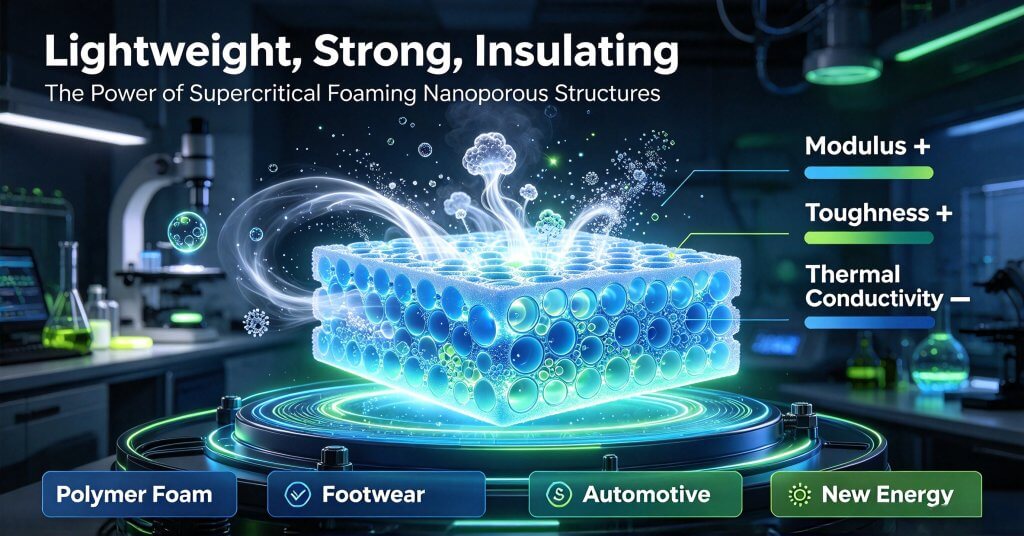
Supercritical Foaming Nanoporous Materials: Formation Mechanism, Tuning Means and Performance Advantages
The demand for lightweight and high-performance materials keeps rising across aerospace, electronics, biomedicine, automotive and footwear sectors. Supercritical foaming nanoporous materials stand out thanks to their unique cellular structure, delivering excellent mechanical, thermal and insulation properties, and have become a hot research topic in advanced new materials.
1. Core Difference Between Nanopore and Micropore
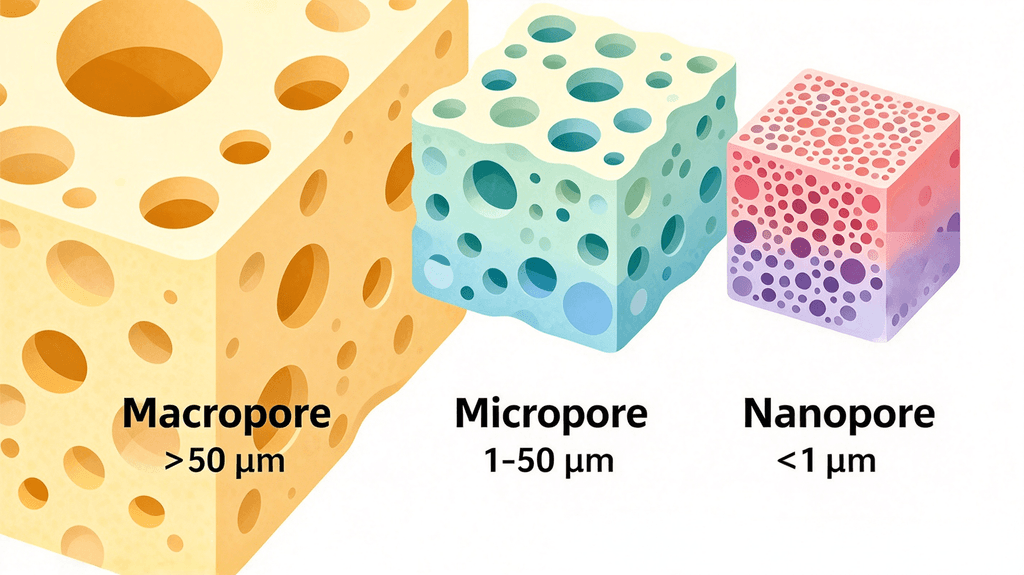
According to ISO standards, foams are categorized by pore diameter:
- Macropore: pore size >50 μm
- Micropore: pore size 1–50 μm
- Nanopore: pore size <1 μm (mostly 10–1000 nm for supercritical foaming)
2. Formation Mechanism of Nanoporous Structure
The creation of nanopores via supercritical foaming is a complex physicochemical process containing four key phases:
- Unique properties of supercritical fluid Supercritical fluid such as CO₂ is above critical temperature and pressure. Its density and diffusion coefficient are highly sensitive to temperature and pressure. Dissolved supercritical fluid reduces polymer glass transition temperature and melt viscosity, preparing for bubble nucleation.
- Bubble nucleation Homogeneous or heterogeneous nucleation creates bubble cells. Heterogeneous nucleation is widely adopted in mass production, using nucleating agents to lower nucleation energy barrier.
- Diffusion and bubble growth from molecular dynamics When the polymer-gas mixture is depressurized, the system turns thermodynamically unstable. Gas diffuses toward bubble nuclei, while polymer matrix deforms to accommodate pore expansion.
- Essential difference vs traditional microporous foam Nanoporous foam features much higher nucleation density (10¹⁵ cells/cm³), driven by fast kinetic nucleation. Microporous foam uses slower thermodynamic nucleation.
3. Four Core Methods to Precisely Control Nanoporous Structure
Pore size, density and distribution can be tuned by coordinated multi-parameter control:
- Temperature control – find the optimal processing window Temperature affects supercritical fluid solubility, polymer diffusion coefficient and rheology. Balancing nucleation driving force and surface tension is critical to get qualified nanoporous foam.
- Pressure control – manage dissolution and nucleation Higher saturation pressure raises CO₂ solubility. Fast depressurization triggers massive nucleation; higher foaming pressure restricts bubble growth for smaller pores.
- Functional additives
- Nucleating agents (SiO₂, talc): create nucleation sites and boost pore density
- Surfactants: reduce interfacial tension and narrow pore size distribution
- Cross-linkers: strengthen melt strength and prevent pore rupture
- Chain extenders: increase molecular weight and raise foaming ratio
- Processing parameters Appropriate holding time allows supercritical fluid to reach diffusion balance. Rapid cooling solidifies pores and improves structural integrity.
4. Performance Comparison: Nanoporous vs Conventional Microporous Foam
Mechanical Performance
At identical density, nanoporous foam features higher elastic modulus, greatly improved toughness and outstanding impact absorption, enabling transition from brittleness to ductility.
Thermal Performance
Thermal conductivity can reach as low as 0.015 W/(m·K), only half of traditional EPS foam. It also delivers lower thermal expansion and better thermal stability.
Insulation Performance
Outstanding electrical insulation, high-performance thermal insulation and sound insulation.
Other Functional Benefits
Improved barrier property against oxygen and water vapor, optical performance for anti-reflection films, and high specific surface area for catalysis and drug release.
5. Summary & Outlook
With special formation mechanism and precise tuning technology, supercritical foaming nanoporous materials achieve breakthrough performance in mechanics, thermal and insulation fields, showing huge potential in many high-end industries.
Future R&D will focus on deeper mechanism research, intelligent control, multi-functional material design and industrial scaling. However, mass production of nanoporous foam still faces obstacles, requiring continuous optimization of materials, processes and equipment.
Yate New Materials specializes in advanced foam materials including ETPU for footwear and new energy applications. We continuously invest in supercritical foaming innovation to deliver high-performance, customized foam solutions for global clients.